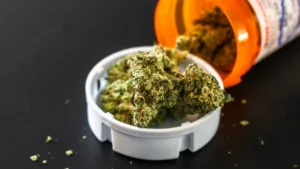
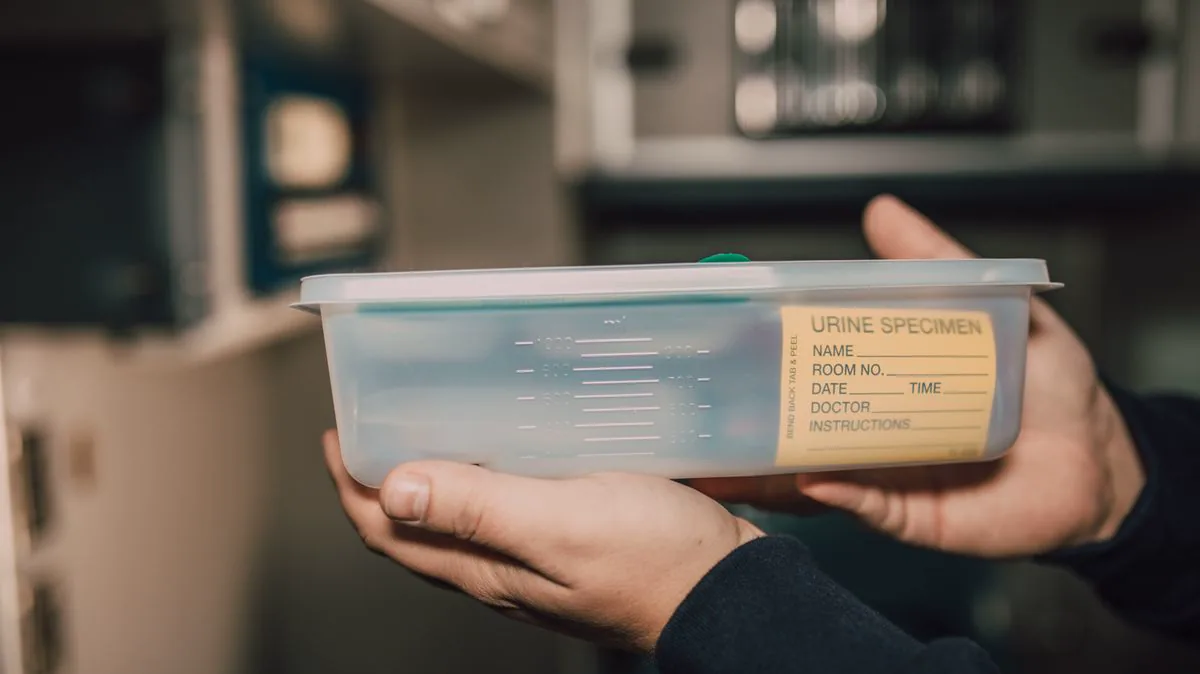
Search for how to pass a urine drug test for cannabis and you will find thousands of pages promising a fix in twenty-four hours. The chemistry is far less accommodating. Urine tests do not look for THC at all, they look for a metabolite the body clears at its own pace, and that pace is driven mostly by how much and how often someone has used.
This is not a guide to beating a screening. It is a look at what toxicology has actually measured under controlled conditions: how long cannabis really stays detectable in urine, what detox drinks do and do not do, how labs check whether a sample has been tampered with, and what the legal exposure looks like if you try.
The short version, for anyone who only wants that: there is no scientifically validated way to meaningfully speed up THC elimination. What does exist is a fairly precise body of data on how long the body takes to do it on its own.
What a urine test is actually measuring
Urine screens do not target delta-9-THC, the compound responsible for the high. They target 11-nor-9-carboxy-THC (THC-COOH), the terminal metabolite of THC. It is pharmacologically inactive, it produces no effects whatsoever, and it can keep showing up weeks after the last use.
That distinction carries real weight. A positive urine result proves cannabis was consumed at some point in the recent past, but it says nothing about whether the person is impaired at the moment of the test. Toxicology reviews have made this point for years, and it is finally showing up in statute. Since January 2024, California’s AB 2188 makes it unlawful for most employers to penalize a worker based on non-psychoactive cannabis metabolites found in urine, hair or blood. New York, New Jersey and Nevada have adopted comparable off-duty use protections, with carve-outs for federally regulated and safety-sensitive roles.
If the goal is detecting recent use or impairment, blood (which measures active THC) and oral fluid do a better job. Urine measures history.
The thresholds that decide the outcome: 50 and 20 ng/mL
A test does not go positive because a trace is present. It goes positive because a specific cutoff is exceeded. The dominant standard in workplace screening is 50 ng/mL of THC-COOH, the federal cutoff that most of the industry has adopted.
Some programs run tighter. Drug courts, treatment settings and certain regulated sectors often use 20 ng/mL. And when an initial immunoassay screen comes back positive, the specimen goes to confirmation by gas chromatography-mass spectrometry, typically at a 15 ng/mL cutoff.
The gap between 50 and 20 ng/mL is not a technicality. For a daily user it can double or triple the detection window. Knowing which threshold applies changes the entire calculation.
Monitored abstinence: the study that put numbers on it
The benchmark data came out of the Journal of Analytical Toxicology in 2008, from Marilyn Huestis’s group at the National Institute on Drug Abuse. Sixty cannabis users stayed on a closed research unit for up to 30 days of round-the-clock monitored abstinence, which removed any possibility of covert use. The team analyzed 6,158 individual urine specimens.
Participants were grouped by their creatinine-corrected THC-COOH concentration on admission. At the 50 ng/mL cutoff, the results were clear:
- Low initial concentration (0-50 ng/mg): first negative at 0.6 days on average, last positive at 4.3 days.
- Intermediate (51-150 ng/mg): first negative at 3.2 days, last positive at 9.7 days.
- High (above 150 ng/mg): first negative at 4.7 days, last positive at 15.4 days.
One finding rarely mentioned elsewhere: negatives and positives alternate. Someone can screen negative on day four and positive again on day seven, because excretion is not linear. A single negative home test guarantees nothing about the next one.
Occasional use versus daily use
The detection data compiled by California NORML from the toxicology literature describes two very different situations. After a single, isolated use, most people screen negative at 50 ng/mL within two to three days, with at least one documented case reaching six days after a large oral dose.
For daily, sustained use, the range widens dramatically: one to three weeks is typical, and some cases run well past a month. At the more sensitive 20 ng/mL cutoff, chronic users have been documented testing positive as far out as 80 days. An Australian case report described detectable metabolite after 102 days of abstinence in a hospitalized patient.
These outliers are exceptions, not the rule. But they explain why no generic internet chart can tell any individual when they will clear. The person-to-person variation is enormous.
Why THC lingers: body fat and slow release
THC is strongly lipophilic. It accumulates in fat tissue and diffuses back into the bloodstream slowly over days or weeks, which is why elimination is far slower than for almost any other common drug.
That mechanism produces a counterintuitive result. A 2013 study by Wong and colleagues put fourteen regular cannabis users through 35 minutes on a stationary bike and measured plasma cannabinoids before, immediately after and two hours later. Exercise increased plasma THC concentrations through lipolysis, releasing THC stored in fat. The effect was modest and gone within two hours, and it correlated positively with body mass index.
In plain terms: the folk advice to sweat it out with a hard workout right before a test may work slightly against you. If you exercise, the sensible move is to avoid doing it in the hours immediately before giving a sample.
Detox drinks and kits: what they actually do
Products marketed as THC detox do not remove metabolites from the body. They work by dilution. You drink a large volume of fluid, urine comes out more dilute, and THC-COOH concentration drops below the cutoff for a few hours.
The rest of the formula exists to hide the dilution. B vitamins restore yellow color to urine that would otherwise run nearly clear, and creatine is included to push urinary creatinine back up, since that is one of the parameters the lab checks. The masking effect is temporary. Available data put it at roughly eight to ten hours before levels return to baseline.
No clinical trial supports the claim that any ingredient in these products accelerates THC metabolism. And drinking excessive volumes of water is not risk-free: it can cause electrolyte imbalance and hyponatremia.
Labs test the specimen, not just the drugs
This is where the dilution strategy falls apart. Laboratories run specimen validity testing, a set of checks on the urine itself. The federal criteria are published:
- Dilute: creatinine below 20 mg/dL combined with specific gravity under 1.003.
- Substituted: creatinine below 5 mg/dL with specific gravity outside the physiological range.
- Adulterated: nitrite or other oxidants at or above 500 µg/mL. Bleach, chromium (VI), iodine and peroxides are also screened for.
- Invalid: pH outside range or interference with the assay.
A specimen flagged as dilute, substituted or adulterated is generally treated by employers and courts the same as a positive, and sometimes worse, because it implies intent to deceive. On top of that, at least 18 states have passed laws criminalizing the sale or use of synthetic urine to defraud a drug screening. Oklahoma, Tennessee, Texas, Ohio, Arkansas, Nebraska, North Dakota and Louisiana all have statutes on the books.
False positives: CBD, hemp and unreliable labels
A positive does not always mean deliberate cannabis use. A University of Pennsylvania study published in JAMA found THC in 21% of CBD products purchased online without it appearing on the label.
Researchers at Johns Hopkins Medicine went further, showing that a single vaping session with a hemp product of legal cannabinoid composition can produce a positive on standard workplace urine screens. In a separate arm, half the participants tested positive for THC-COOH after four weeks of hemp product use.
Pure CBD will not trigger a positive. Real-world CBD and hemp products, carrying trace THC and used repeatedly, can and do, through accumulation.
How common are positives, and what does the trend say
The Quest Diagnostics Drug Testing Index, which analyzes millions of workplace results a year, reported marijuana positivity holding steady at 4.5% in the general U.S. workforce. Rates vary sharply by test type: 10.4% in oral fluid and 9.8% in hair, both far above urine, and post-accident positivity ran at 7.3%.
Marijuana remains the most frequently detected substance in workplace testing by a wide margin. At the same time, a growing number of employers in legal-market states have dropped THC from pre-employment panels entirely, precisely because a urine positive tells them so little about job fitness.
The honest conclusion: only time works
After reviewing the evidence, the takeaway is uncomfortable but straightforward. Abstinence is the only reliable method, and the timeline depends on prior use frequency, the cutoff in play, and individual factors such as body fat.
For occasional use, a few days is usually enough. For daily use, plan on weeks, and in rare cases more than a month. Home urine tests bought at the same cutoff the lab will apply are the only sensible way to gauge where you stand, keeping in mind that one negative is not the final word.
It is worth returning to the point we opened with. The underlying problem is that these tests measure history, not capability. As long as the standard is an inactive metabolite that persists for weeks, people will keep facing consequences for legal use that happened on their own time and has no bearing on their performance. That debate is already reshaping the law in several states.
Este artículo también está disponible en español: Test de orina y cannabis: cuánto dura el THC y qué dice la ciencia sobre los «detox».