
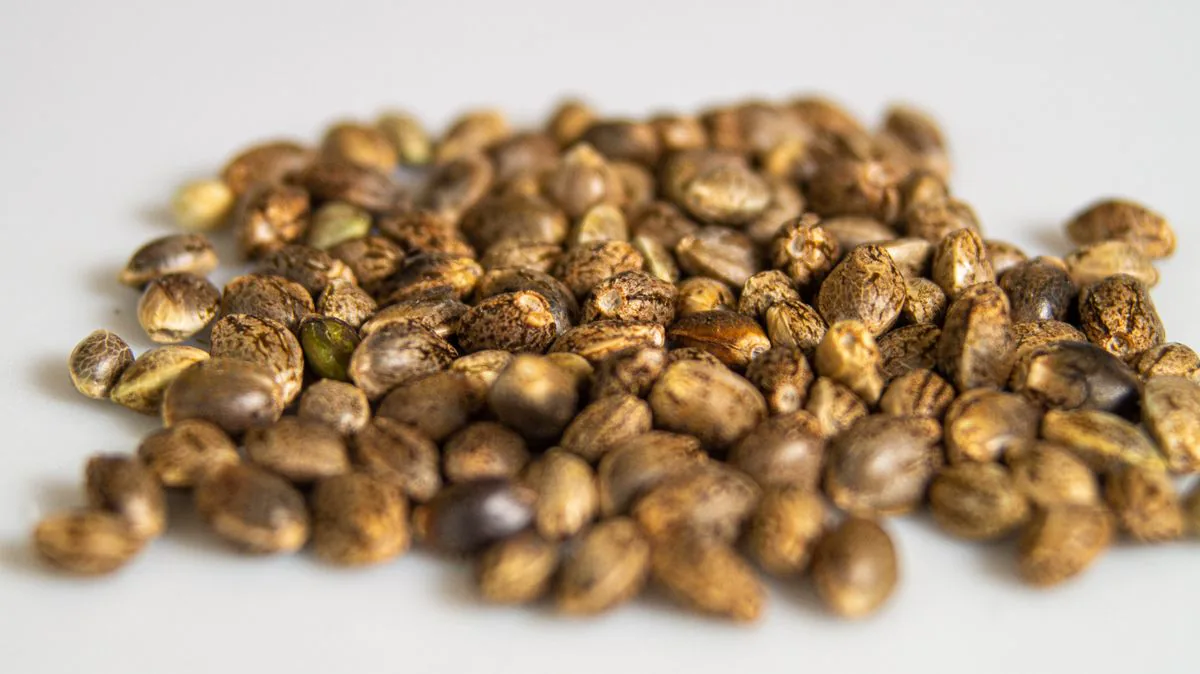
Open a pack of cannabis seeds for the first time and you may expect something like a sunflower kernel. What you get instead is a small oval body, a few millimetres across, hard, glossy and usually streaked with dark markings. That appearance is the first — and often the only — piece of information available before germination, which is exactly why so much folklore has grown around it.
The awkward part is that appearance tells you considerably less than most growers assume. It is useful for spotting clearly immature or damaged seeds, but it predicts nothing about plant vigour, sex or potency. Several of the most repeated tricks on grower forums — pinching the seed between your fingers, dropping it in a glass of water — have little or no evidence behind them.
Here is what a cannabis seed actually looks like, what morphology research says about size, shape and colour, which signals deserve attention and which are worth ignoring.
It is not even a seed: it is a fruit
Botanically, what everyone calls a cannabis seed is an achene: a dry fruit that does not split open at maturity and contains a single seed inside. The hard, shiny shell is the pericarp, the fruit wall. The seed proper, with its coiled embryo and two cotyledons, sits within it.
This is not pedantry, because it explains the famous striping. The pattern does not belong to the fruit itself but to the perianth, the floral envelope of the female flower, which stays glued to the achene as it ripens. Each fertilised female flower produces exactly one achene, and it takes roughly three to eight weeks to finish developing.
In work by Naraine, Small and colleagues published in Genetic Resources and Crop Evolution (2020), that perianth adherence turned out to be one of the traits separating wild from domesticated populations: achenes from cultivated plants are longer, heavier and carry a less adherent perianth than those from ruderal stands.
Size and weight: the actual numbers
The figure repeated across the botanical literature is a range of 2 to 5 millimetres long, but the fine-grained data shows more variation than that suggests.
A genetic mapping study published in the journal Plants in December 2025 measured 147 seed lots from an F2 population and recorded lengths of 3.9 to 6.0 mm (mean 5.0 mm) and widths of 3.4 to 5.4 mm (mean 4.1 mm). Hundred-seed weight ranged from 0.7 to 4.4 grams — roughly 7 to 44 milligrams per seed.
In the same paper’s diversity panel of 84 accessions from 14 countries, the gap between the lightest and heaviest hundred-seed weight was more than eightfold. Two of the parent lines weighed 11.0 and 53.4 milligrams per seed respectively.
The practical takeaway is blunt: there is no “correct” size. Calibre is a varietal trait under multi-gene control, and a small seed from a small-seeded cultivar is entirely normal.
Shape, by contrast, is consistent: oval to ellipsoid, slightly flattened on the sides, with a fine ridge (the raphe) running along the edge and a somewhat pointed base where the achene was attached to the plant.
Colour: from pale beige to near-black
The normal range runs from light beige through browns and greys to olive tones and almost black. Some seeds throw green or bluish reflections depending on the light, and nearly all carry a waxy layer that gives them their sheen.
The most quoted quantitative comparison comes from that same 2020 study: achenes from marijuana varieties were on average about 26% shorter and roughly 32 shades darker on a 256-level greyscale than industrial hemp achenes. Those are group averages, not a test you can apply to a single seed on your desk.
The darkening and mottling serve an ecological purpose: camouflage. A speckled achene on bare soil is harder for birds to spot, and natural selection has favoured that colouring in wild populations.
Tiger stripes: what they are and what they really mean
The irregular dark veining many growers call tiger stripes is, as explained, leftover perianth tissue. Its presence indicates the seed finished ripening inside the flower and that the layer survived subsequent handling. It is a reasonable signal, but a weak one.
Its absence is not a defect. Some cultivars produce smooth seeds by genetics, and the perianth rubs off easily during handling, sieving or shipping. A smooth, firm, well-formed seed germinates just as readily as a striped one.
The reverse also holds: striping guarantees nothing. A seed can display textbook marbling and still be dead from poor storage.
Immature seeds: pale, soft and light
Here there is a genuinely reliable visual cue. Seeds harvested too early are white, pale green or yellowish, with a thin shell that gives under the slightest pressure. They are often smaller and sometimes shrivelled.
These seeds never accumulated reserves or hardened their pericarp, and their germination rates are appreciably worse. It is the one case where discarding on appearance is justified.
The caveat matters: what counts is firmness combined with fill, not shade. Naturally light-coloured cultivars exist and germinate fine. A beige seed that is hard and feels heavy for its size is a good seed; a dark seed that is soft and hollow is not.
What appearance cannot tell you
This deserves to be stated flatly, because it causes most of the disappointment:
- Sex is invisible. Feminised and regular seeds are visually identical. No pattern, shape or “little hole” reveals whether a seed will produce a female plant.
- Autoflowering versus photoperiod is invisible too. There is no external marker.
- Age is invisible. A badly stored five-year-old seed looks exactly like a three-month-old one.
- Potency cannot be eyeballed.
That last point comes with an interesting footnote. Márquez and colleagues published a geometric morphometrics analysis in Cannabis and Cannabinoid Research (2022) covering achenes from five varieties across three chemotypes. Type I (THC-dominant) varieties had rounder, larger seeds, while Type III (CBD-dominant) varieties had slimmer, smaller ones, and the authors proposed achene shape as a possible preliminary biomarker of the plant’s cannabinoid profile.
That said, the method involves digitising outlines and running multivariate statistics on controlled samples — not looking at a seed. The authors themselves note that broader diversity and control of environmental effects are needed before the approach has any practical use.
The squeeze test and the float test: two stubborn myths
Pinching a seed between thumb and forefinger to see whether it “holds up” is a bad idea. Any seed will crack under enough force, so cracking proves nothing about whether it was dead, and the margin between feeling firmness and crushing the embryo is very narrow. Breeders such as Dutch Passion explicitly advise against it because of how many viable seeds get destroyed this way.
The sensible version is to roll the seed gently between your fingers to feel whether it is hollow or spongy, without ever trying to break it.
The float test is even less informative. Buoyancy depends on air trapped in the achene cavity, surface wax and moisture content: a freshly harvested seed holding more water sinks faster than a dry, perfectly viable one. Plenty of seeds float for hours and then germinate without trouble. There is no solid correlation between sinking and sprouting.
How viability is actually assessed
A seed laboratory does not look at colour. It uses three methods:
- Germination testing under ISTA protocol. This is the reference standard and takes a minimum of seven days.
- Tetrazolium testing. Seeds are incubated in a 1% triphenyl tetrazolium chloride solution, typically for 18 hours at 30 °C: living tissue stains red, dead tissue does not. A rapid protocol specific to hemp published in 2020 delivers a result in around three hours.
- X-ray imaging. ISTA accepts X-rays as an alternative to the cutting test for detecting empty or insect-damaged seeds, and it shows the embryo without destroying the sample.
The first two are destructive and the third needs equipment. For anyone with a handful of seeds at home, the only real test is still germinating a small sample. Breeders working with fresh, cold-stored stock report rates of 90 to 95%, which is a fair benchmark.
Storage: freshness beats looks
Between an ugly recent seed and a beautiful one that has spent six years in a drawer, the ugly one usually wins. The conditions repeated across the literature are consistent:
- Stable, low temperature, between 4 and 10 °C.
- Low relative humidity in the container and an internal moisture content of 5 to 7% for long-term storage.
- An airtight, opaque container with silica desiccant.
- Complete darkness and no temperature swings.
The most common mistake is condensation: pulling the jar out of the fridge and opening it warm deposits water directly onto the seeds. Let the sealed container come up to room temperature before opening it.
Under good conditions, germination rates hold up reasonably for several years and start dropping noticeably after year three to five. There are documented cases of seeds sprouting after more than a decade in cold storage, but they are the exception rather than the rule.
Seeds and the law in the United States
The legal status of cannabis seeds in the US shifted with a DEA letter dated 6 January 2022, signed by Terrence L. Boos of the agency’s Drug and Chemical Evaluation Section in response to an inquiry from attorney Shane Pennington. It confirmed that cannabis seeds containing no more than 0.3% delta-9 THC by dry weight meet the federal definition of hemp under the 2018 Farm Bill and are therefore not controlled substances — regardless of whether the resulting plant would qualify as marijuana.
The material reason is the same one that applies elsewhere: cannabinoids are produced in the trichomes of the flowers, not inside the fruit, so a seed carries negligible THC.
What that letter does not do is authorise growing. Cultivation remains governed by state law, and home-grow allowances vary widely: some states permit a set number of plants per adult or per household, others allow none at all, and it stays a federal offence regardless of state permission. Buying seeds legally and germinating them legally are two separate questions.
What to look at and what to ignore
Worth checking: firmness, shell integrity (cracks, insect holes, mould spotting), whether the seed feels as heavy as its size suggests, and whether it is pale and soft at the same time. And above all, something that is not on the seed itself — the source and the date of the lot.
Worth ignoring: tiger stripes as a guarantee, size as a proxy for quality, dark colour as a mark of excellence, and whatever the glass of water says. These are noisy signals that cause more unfair rejections than correct calls.
Honesty requires closing where we began: appearance points you in a direction, it does not settle anything. The only conclusive proof that a seed was alive is that it sprouts.
Este artículo también está disponible en español: Cómo son las semillas de cannabis: guía visual para identificarlas.