Madrid has a reputation as a cannabis-friendly city, and many visitors arrive expecting something like Amsterdam. The reality is different: there are no licensed shops, buying in the street is illegal, and the city’s cannabis social clubs are private associations that do not advertise. That gap between expectation and reality is exactly where scammers operate.
This guide covers the most common weed scams in Madrid, from street sellers around Puerta del Sol to fake clubs that take payment online and disappear. It also explains how genuine clubs work, so you can tell the difference.
One caveat up front: there are no official statistics on cannabis scams. Victims rarely report them, because the underlying transaction is illegal or legally murky. What follows is based on how Spanish law works, on documented police cases involving tourists, and on the way legitimate associations are required to operate.
Why tourists are an easy target in Madrid
Three factors make visitors vulnerable. First, the widespread belief that “weed is legal in Spain”, which is only partly true: private adult consumption is tolerated, but sale is not legal and public possession is fined. Second, a lack of visible, legal options, since clubs are expected not to advertise to the public. Third, time pressure: a tourist with a three-day stay is more likely to take shortcuts than a resident.
Scammers know all of this. Their pitch almost always promises the same thing: speed, certainty and no questions asked. Those are precisely the things a legitimate club cannot offer.
Packing your own supply is not a safe alternative. Bringing THC products into Spain by plane is treated as smuggling, as explained in our guide on whether you can fly with cannabis to Spain.
Scam 1: street sellers around Sol and the city center
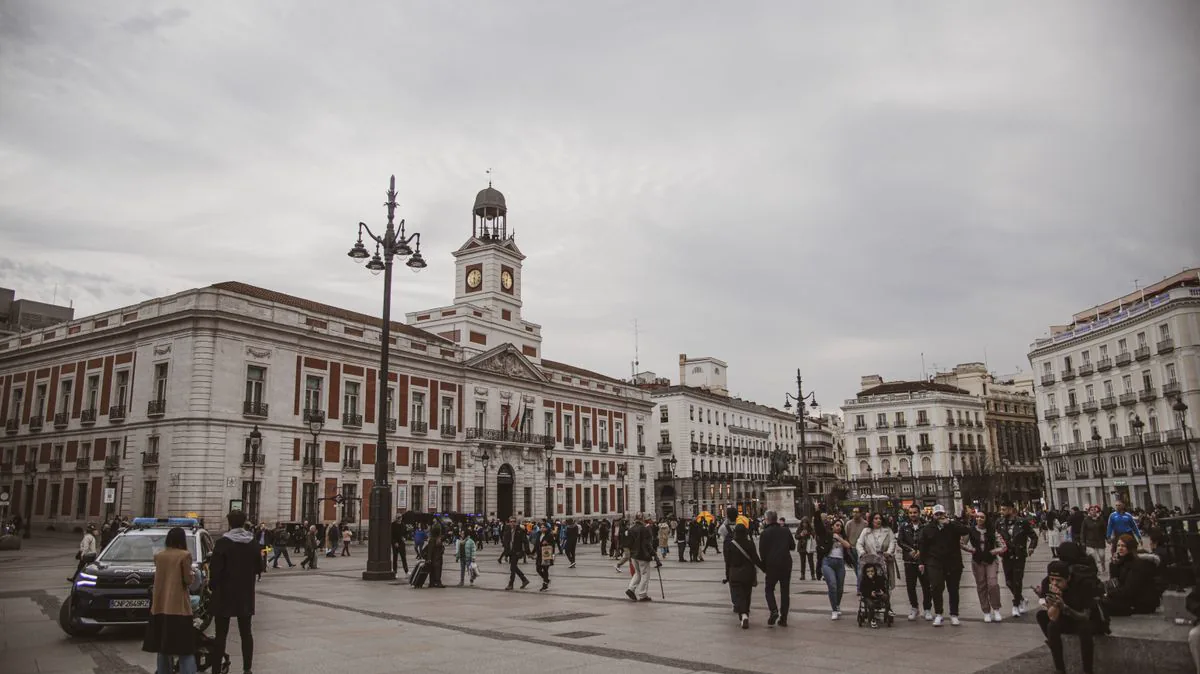
The most visible risk is the person who approaches you near Puerta del Sol, Gran Vía or Plaza Mayor and quietly offers “hash” or “weed”. Any purchase like this is a gamble on several fronts.
The product may be short weight, mostly filler or not cannabis at all. It may also be adulterated. The European Union Drugs Agency warns that cannabis sprayed with synthetic or semi-synthetic cannabinoids can look identical to ordinary cannabis and be sold to unsuspecting buyers, with risks that range from mild side effects to poisonings requiring hospital care.
Then there is the law. Buying, carrying or consuming cannabis in a public place is a serious offense under Article 36.16 of Spain’s Public Safety Law (Organic Law 4/2015), with fines that start at 601 euros. A 20 euro street deal can easily turn into a fine thirty times larger. And if you are driving, the rules are even stricter: Spain fines the mere presence of THC at the wheel, as covered in our guide to driving after using cannabis in Spain.
Scam 2: “promoters” who sell you an invitation
A more polished version targets people who have heard about clubs. Someone on the street, in a hostel or on social media offers to “get you in” to a club for a fee, often 20 to 50 euros on top of whatever the club charges. Sometimes they walk you to a real club; sometimes they take the money and vanish.
Even when the club is real, the model is a problem. Legitimate associations admit new members through the referral of an existing member who knows them, not through paid intermediaries. Clubs that rely on street touts to recruit tourists are behaving like businesses selling to the public, which is precisely what Spanish courts say they cannot do. Those venues are more likely to be raided and closed.
Scam 3: fake clubs that take payment online
This is the scam that costs visitors the most. A website, social media profile or messaging account presents itself as a Madrid club. You are asked to pay a membership fee in advance by bank transfer, cryptocurrency, gift cards or an instant payment app, with the promise that your card will be ready when you arrive.
When you get to the address, there is no club, or the account has blocked you. Some variants go further and offer “delivery” to your hotel, sending a menu with photos and prices. That is not a club: it is street dealing by phone, and if the cannabis arrives at all, you have no idea what it contains.
Real associations do not sell memberships remotely to people they have never met, and they do not deliver. Any request for payment before you have set foot in the premises is a red flag.
Scam 4: inflated fees and “tourist” surcharges
Some venues that do exist charge far more than a normal association would. The tactics include a high “registration fee”, a “VIP” or “lifetime” membership, a separate “tourist fee” or a mandatory minimum spend on the first visit.
For reference, the annual membership fee at Madrid clubs is typically in the range of 20 to 50 euros. A demand for 100 euros or more just to get through the door is a strong sign that you are dealing with a business targeting tourists rather than an association serving its members.
Scam 5: fake police
Spanish police have dismantled several gangs that posed as officers to rob tourists, in some cases claiming to be running anti-drug operations. The script is simple: two people stop you, flash an “ID”, say they are checking for drugs or counterfeit money and ask to inspect your wallet. When you hand it over, cash and cards disappear.
Real Spanish police officers carry a badge and a professional ID card, which you are entitled to see. Drug fines are handled through a formal administrative procedure with a written report, not by collecting cash in the street. If something feels wrong, ask for identification, do not hand over your wallet, move to a busy place and call 112 or the National Police on 091.
How a real cannabis club in Madrid works
Spanish cannabis social clubs are non-profit associations of adults who pool resources so that members can consume privately on the premises. There is no specific law regulating them; their legal space comes from case law. A key 2015 Supreme Court ruling (STS 484/2015) accepted shared consumption only within a closed and limited circle of members, and warned that open admission or sales to the public can be prosecuted as drug trafficking.
In practice, a legitimate club in Madrid usually works like this:
- It has a physical address where you can see the premises before paying anything.
- Admission requires the referral of an existing member and a valid ID or passport.
- The legal minimum age is 18, and many clubs set it at 21.
- The annual fee is typically 20 to 50 euros, paid on site.
- Consumption happens inside; clubs do not deliver and do not advertise prices to the public.
Clubs differ in their rules, and some will not accept short-stay visitors at all. That is not a scam; it is how a cautious association protects itself.
Clubs are not a medical service either: a US state card gives you no special status in a Spanish association, as we explain in our guide to the medical marijuana card in Spain.
Red flags at a glance
- Payment requested before you visit, especially by crypto, gift cards or instant payment apps.
- A “club” with no fixed address, or an address that changes.
- Guaranteed entry for anyone, the same day, with no referral and no ID check.
- Price lists or “menus” sent over WhatsApp or Telegram, or offers of delivery.
- Fees of 100 euros or more, or extra charges labeled as tourist or VIP fees.
- Street approaches near tourist landmarks.
The safe route, and what to do if you have been scammed
The safest approach is the slow one. Use the map and directory of clubs on Weedestiny to look for associations with a real, physical address, check the area before you go, and expect to follow the club’s admission process rather than skip it. Never pay in advance for a membership or a guarantee of entry.
If you have paid a fake club or been robbed by fake officers, that is a crime and you can report it. In central Madrid, the Foreign Tourist Assistance Service (SATE), run with the National Police at Calle de Leganitos 19, helps visitors file reports and cancel cards. Be realistic, though: recovering money sent by crypto or gift card is rarely possible.
Bottom line
Most cannabis scams in Madrid exploit the same misunderstanding: the idea that cannabis can be bought quickly and openly, as in a coffeeshop. In Spain it cannot. The legal space is private consumption within a closed association, and that model is slow by design.
If an offer is fast, guaranteed and paid in advance, it is almost certainly not legitimate. Stay out of street deals, ignore the touts, and only deal with clubs you can visit in person at a real address.
Este artículo también está disponible en español: Estafas con el cannabis en Madrid: cómo engañan a los turistas y cómo evitarlas.