
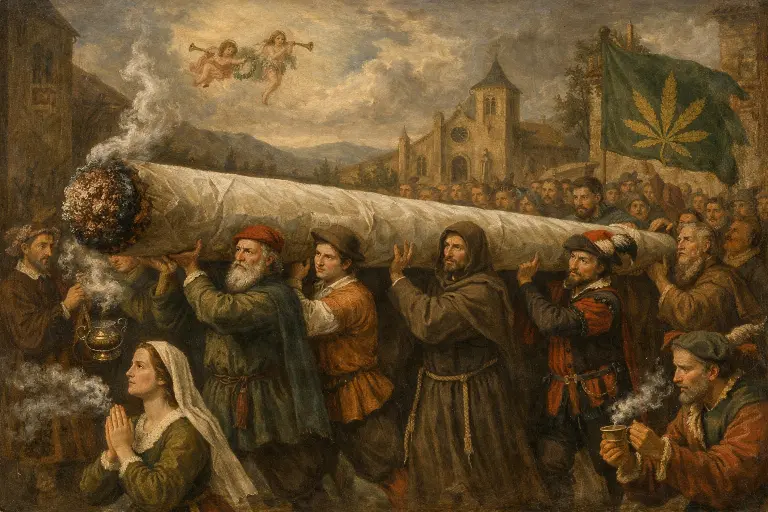
Every February, the town of Chella experiences one of the most unique celebrations in the Valencian Community. The event known as San Fumat blends carnival, satire, tobacco tradition, and an atmosphere where smoke—both from traditional caliqueños cigars and cannabis joints—becomes a visible part of the ritual.
However, this year the celebration has been surrounded by rumors. The absence of the usual police escort during the procession has caused concern among some residents, who fear that the tradition may be under scrutiny and that its future could be uncertain.
So what does San Fumat really represent? Why does it attract so much attention? And what exactly is happening this year?
What Exactly Is San Fumat in Chella?
San Fumat is a pagan and grotesque procession held during Chella’s patron saint festivities honoring the Virgin of the Candelaria, Saint Blaise (San Blas), and the Christ of Refuge (Cristo del Refugio).
The event takes place late at night, usually after the town’s main party or open-air dance ends, when the festive atmosphere is already relaxed and uninhibited.
The main character is a fictional saint called San Fumat. He does not belong to any religious canon but is instead a satirical creation of local tradition. The effigy, built the same day using everyday materials, usually carries an oversized cigar as a symbolic element.
After the night concert at the municipal auditorium, residents—often wearing costumes—start the procession carrying candles and caliqueños, accompanied by musicians. The group walks through the streets surrounded by smoke until reaching the town promenade, where the effigy is burned in a final act of celebration.
The scene is clearly carnivalesque and humorous. And yes, besides the traditional cigars, it is also common for some participants to smoke cannabis joints during the procession, something that has historically been part of the event’s irreverent and relaxed spirit.
A Tribute to Chella’s Tobacco History
To understand the Stoner Festival San Fumat in Chella, it is important to know the town’s connection with tobacco.
During the 19th and 20th centuries, the handmade production of caliqueños cigars was widespread in the area and provided an economic lifeline for many local families.
In many cases this production occurred within households and informal economies, often carried out by women. Over time, caliqueños became a cultural symbol of the town.
San Fumat emerged as a playful and ironic homage to this tobacco heritage. The unofficial “rule” that participants attend in costume and smoking a cigar directly references that past.
Over the years the celebration evolved. What began as a humorous tribute to handmade cigars gradually became a night where tobacco and sometimes cannabis consumption coexist within a festive, carnival-like environment.
An Irreverent Procession That Breaks With Religious Tradition
Chella’s patron festivities combine deeply religious ceremonies with lively community events. During the celebrations there are processions, masses, fireworks (mascletás), concerts, and cultural activities.
Within this solemn framework, San Fumat acts as a rebellious counterpoint. It is a parody procession that breaks with traditional religious solemnity and symbolically closes the festive cycle.
The burning of the effigy resembles other Valencian traditions where a figure is destroyed to mark the end of a celebration.
Here, however, the tone is satirical and playful, and the smoke—whether from cigars or joints—becomes part of the visual landscape of the night.
Is the San Fumat Festival in Danger?
This year something unusual happened: the procession did not have the usual police escort.
Although no official announcement has suggested that the festival will be canceled, the absence has fueled speculation among residents. Some believe that new authorities may be uncomfortable with an event where tobacco and cannabis consumption are openly visible.
In a context where public consumption regulations are increasingly strict, events like San Fumat can generate tension between tradition and modern regulatory frameworks.
San Fumat has always carried a provocative spirit, but today that rebellious character may clash with greater institutional oversight.
Popular Tradition vs. Changing Social Sensibilities
The debate is complex.
On one hand, San Fumat is a local tradition with more than two decades of history, organized largely by young residents and festival committees, deeply embedded in the town’s identity.
On the other hand, social attitudes and legal contexts have evolved. Visible cannabis use during a public procession can create controversy, especially when the event is tied to official patron celebrations.
The key question is whether the tradition can adapt without losing its essence, as many cultural festivals have done over time.
More Than Smoke: Identity and Community
For many locals, San Fumat represents much more than a night of smoke.
It is a symbol of community, a moment where generations mix, costumes erase social hierarchies, and humor unites the town.
It also serves as a satirical reminder of Chella’s tobacco heritage, reinterpreted through carnival spirit and collective celebration.
If the festival ever disappeared, it would not just mean the end of a bonfire—it would represent the loss of a distinct cultural expression of the town’s contemporary identity.
For now, San Fumat continues to wind through Chella’s streets among music and smoke. The question is whether it will continue unchanged in the coming years or whether it marks the beginning of a transformation shaped by modern times.
When Is San Fumat?
San Fumat takes place every year during Chella’s patron festivities, specifically in the early hours of February 2, coinciding with the Day of the Virgin of the Candelaria.
The procession begins after the main festival dance (verbena) organized as part of the official celebrations, usually late at night or after midnight.
It is important to understand that San Fumat is not a religious ceremony, but rather a pagan, carnival-style procession that contrasts with the solemn events dedicated to the Candelaria, San Blas, and the Christ of Refuge.
The central moment of the celebration is the appearance of the San Fumat effigy, created the same day. From there, residents—often in costume and carrying cigars—walk through the streets accompanied by music and smoke until reaching the location where the figure is burned in a symbolic finale.
Because it is tied to the Candelaria celebrations, the date remains stable each year: the early hours of February 2.
When Are Chella’s Festivities?
Chella’s patron saint festivities traditionally take place between February 2 and February 4, although in recent years the program has expanded to include events before and after those dates.
The celebrations honor:
- The Virgin of the Candelaria (February 2)
- Saint Blaise – San Blas (February 3)
- The Most Holy Christ of Refuge – Cristo del Refugio (February 4)
During these days the town hosts religious ceremonies, processions, fireworks, concerts, parades, and community events.
San Fumat is one of the most distinctive celebrations within this program, especially popular among younger participants.
What Are the Patron Festivities of Chella?
Chella’s patron festivities are dedicated to three main figures:
- The Virgin of the Candelaria
- San Blas (Saint Blaise), patron saint of the town
- The Christ of Refuge
The celebrations combine religious devotion, popular traditions, and festive entertainment.
February 2 focuses on the Candelaria celebrations, including religious ceremonies and processions.
February 3 honors San Blas, traditionally including the blessing of bread rolls (rollos de San Blas).
February 4 is dedicated to the Christ of Refuge, one of the most solemn days of the program.
Alongside these ceremonies, the town organizes concerts, fireworks displays, parades, and parties.
Within this festive framework, San Fumat stands out as a humorous and irreverent event, known for its night procession and the final burning of the effigy—making it one of the most recognizable and unusual traditions in the Canal de Navarrés region.