
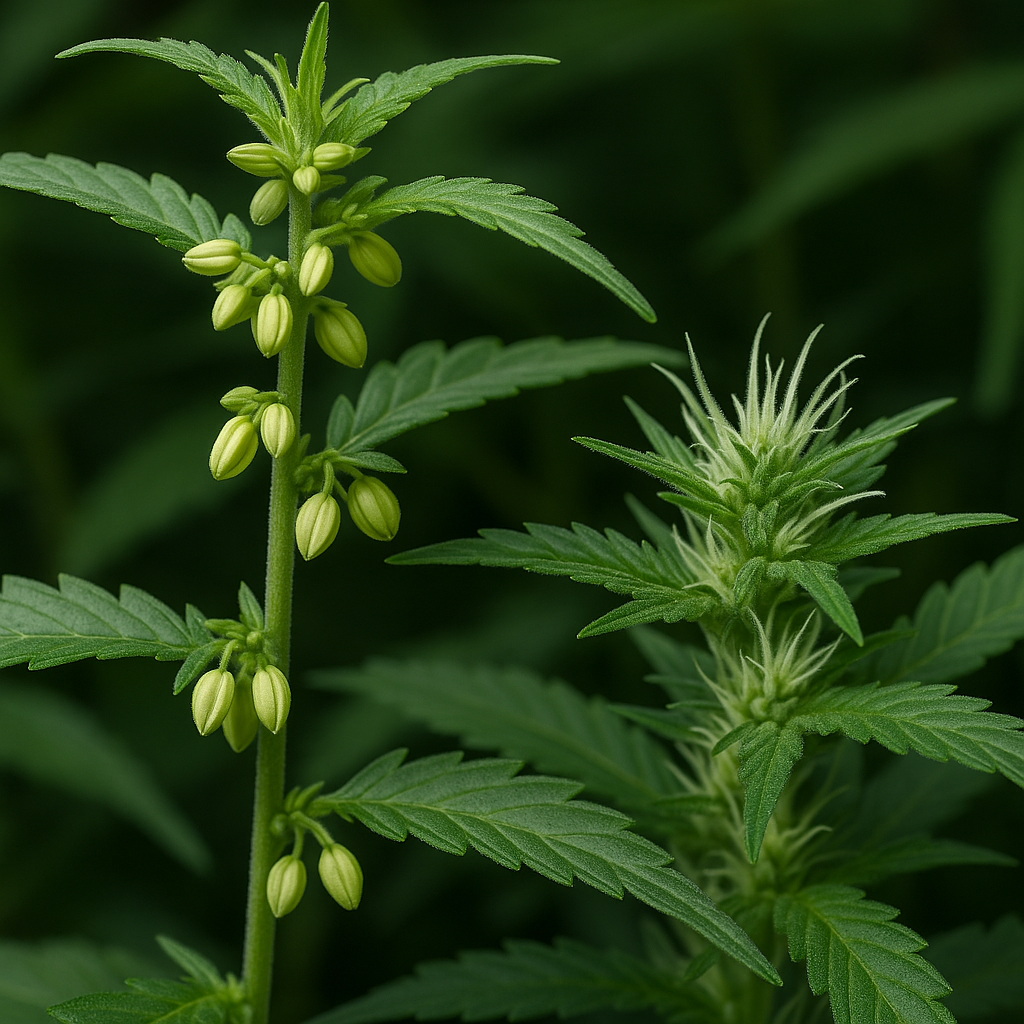
Male marijuana is one of the two sexual forms a cannabis plant can have. Unlike the female plant, it does not produce buds rich in THC or other cannabinoids. Instead, it develops pollen-filled flowers that are necessary to fertilize female plants and generate seeds. Its presence is essential for reproduction and the creation of new genetics. However, it can be harmful in crops where seedless buds (sinsemilla) are desired. When it releases its pollen, it fertilizes the females, reducing the quality of the harvest.
It can be easily recognized by the small balls or bell-shaped sacs that appear at its nodes, instead of the white pistils seen on female plants. Although it is not used for recreational purposes due to its low THC content, the male marijuana plant offers other uses. It can be used to produce seeds, extract fibers, or create medicinal products. In this article, you’ll learn how to identify it, manage it, and make the most of it in your grow.
What Is a Male Marijuana Plant?
A male marijuana plant is one that develops male reproductive organs—meaning it produces pollen instead of resinous flowers like female plants. Cannabis plants are mostly dioecious, which means there are separate male and female plants. Although hermaphroditic plants can also appear, the most common are clearly male or female individuals.
How to Identify a Male Marijuana Plant
Correctly identifying a male cannabis plant is essential, especially if you want to prevent it from pollinating your females. Unlike female plants, males do not produce buds. Instead, they form clusters of flowers shaped like tiny bells or small round balls called panicles, which contain the pollen. These structures hang downward and, when mature, open up to release the pollen into the air.
Male plants generally develop faster than female ones and show their preflowers around the sixth to eighth week of life, even before changing the photoperiod to flowering. Using a magnifying glass to inspect the nodes can help you determine whether you’re dealing with a male plant.
Key Differences Between Male and Female Marijuana Plants
Male marijuana: produces balls or pollen sacs, does not develop buds, and contains very little THC.
Female marijuana: develops white hair-like pistils and forms resinous, THC-rich buds.
Hermaphrodite: may show characteristics of both sexes, which can also put your crop at risk.
What to Do If You Discover a Male Marijuana Plant
If your goal is to obtain seedless flowers (known as a sinsemilla harvest), you must act quickly. The best approach is to remove the male plant from the grow as soon as it is identified, in order to prevent pollination of the females. If you find a hermaphroditic plant, it’s advisable to examine it carefully to decide whether it can be kept under close supervision or if it’s better to remove it as well.
Alternative Uses of Male Marijuana
Although male marijuana plants are usually discarded in recreational or medicinal grows, they actually have many useful applications:
1. Creation of new genetics
Pollen from male plants is used to create hybrid crosses and preserve strains. Advanced growers select strong, healthy males to enhance resistance, vigor, or flavor profiles in future generations of cannabis.
2. Extracts with low THC content
Male plants contain very little THC, but they can still be used to make salves, tinctures, or oils with anti-inflammatory or relaxing properties. While they do not produce psychoactive effects, they retain small amounts of cannabinoids beneficial for therapeutic use.
3. Production of textile fibers
Male hemp produces longer and more flexible fibers, ideal for making clothing, ropes, backpacks, and other durable textile products. This characteristic has been used for centuries, even for crafting the first sturdy hemp pants.
4. Eco-friendly paper
Thanks to its rapid growth and low space requirements, male marijuana is excellent for producing strong, ecological paper, helping reduce the deforestation caused by the traditional paper industry.
5. Edible seeds
When male marijuana pollen fertilizes female plants, the resulting seeds are rich in proteins, fatty acids, and vitamins. These seeds are highly valued in healthy nutrition and are used in traditional Chinese medicine.
Can You Smoke Male Marijuana?
Technically yes, but it’s not recommended. Male marijuana contains very little resin and extremely low levels of THC, so it does not produce the effects desired for recreational or meaningful medicinal use. Even so, some growers experiment with its upper leaves to make teas or extract cannabinoids in a homemade way.
Is It Worth Keeping a Male Marijuana Plant?
It depends on your goal. If you’re interested in creating new genetics, extracting fibers, or using its roots and seeds, keeping a well-identified male plant can be very beneficial. If, on the other hand, your only goal is to harvest seedless buds, then it’s best to remove it in time.
Is the Male Marijuana Plant a Weed?
Many beginners in cannabis cultivation wonder whether a male marijuana plant can be considered a weed. Although technically it is not, it’s understandable that some growers see it that way, especially when its presence puts a harvest at risk. The male marijuana plant is a completely valid part of the cannabis reproductive cycle, since it produces the pollen needed to fertilize female plants and generate new seeds. However, in grows intended exclusively for producing sinsemilla flowers, its presence is undesirable.
For that reason, when it appears in a grow where reproduction is not desired, it is usually removed quickly, which leads to the perception of it as a “weed.” This association isn’t entirely accurate, because a weed is an invasive plant that grows spontaneously and competes with crops for resources like light, water, and nutrients. The male marijuana plant, on the other hand, is part of the same crop, but simply has a different purpose. In summary, it is not a weed in the botanical or agricultural sense, but it can behave like a threat to the goals of a specific grow—especially when the goal is to obtain high-quality, seedless flowers.
How to Know if a Plant Is Male
Identifying whether a cannabis plant is male is crucial for any grower who wants to avoid unwanted pollination in their crop. Male marijuana plants are mainly distinguished by their floral structure. Instead of the well-known white pistils that females develop, males produce small balls or clustered sacs that resemble tiny bells. These balls are the male reproductive organs, known as panicles, and they contain the pollen that fertilizes female plants.
These structures hang from the stem and, as they mature, they open to release the pollen into the wind. Generally, males show signs of their sex earlier than females, which allows growers to act in time and remove them if pollination is not desired. Another way to detect a male plant is during the pre-flowering stage, between the sixth and eighth week of life. With a magnifying glass, you can observe the plant’s nodes (the intersection between the stem and the branches): if smooth balls with no hairs appear, it is very likely to be a male plant. Unlike females, male plants tend to be taller and more elongated, with fewer leaves at the top. This early identification is essential to protect a cannabis crop from accidental pollination, especially when aiming for a high-quality sinsemilla harvest.
What Causes Weeds?
The term weed refers to any plant that grows in an unwanted place and competes with crops for vital resources. Weeds can be caused by different factors, such as lack of crop rotation, the use of contaminated seeds, wind carrying unwanted seeds, or poor field maintenance. Often, these plants not only interfere with the normal development of crops by absorbing water, nutrients, and sunlight, but they can also carry pests and diseases.
In the context of cannabis, although male marijuana is not a weed itself, if it appears uncontrolled in a grow focused on producing high-quality flowers, it can cause negative results very similar to those of a weed: reduced yields, loss of potency in the buds, and the production of unwanted seeds. True weeds, meanwhile, can establish themselves quickly if there is no adequate control plan—whether manual, mechanical, or chemical. Among the most common species considered weeds in agricultural fields are dandelion, Bermuda grass, thistle, and many others that grow spontaneously. To prevent their appearance, it is essential to properly prepare the soil, use certified seeds, and keep the area free of plant debris or contaminants.
What Happens If I Get Really “High on Weed”?
The expression “ponerse muy marihuano” colloquially refers to consuming an excessive amount of cannabis, especially for recreational purposes. Although marijuana has many medicinal and therapeutic uses, when consumed in excess—whether smoked, eaten, or vaporized—it can cause a series of unwanted effects. The most common symptoms of being “too high” include anxiety, paranoia, rapid heartbeat, confusion, dry mouth, red eyes, and in some cases, a feeling of loss of control or panic.
It’s important to distinguish between the effects of consuming female marijuana—rich in THC and psychoactive—and male marijuana, which contains very low levels of THC and produces almost no psychoactive effects. Therefore, if someone gets “very high,” they most likely consumed a female strain rich in THC. In such cases, the best approach is to stay calm, breathe deeply, hydrate, and wait for the effects to pass, which typically last between 1 and 4 hours depending on the dose and method of consumption. To avoid reaching this state, it’s important to know your tolerance, start with low doses, and be in a safe environment. And if consuming recreationally, always do so responsibly.
Male and Female Marijuana Plants
When talking about a male or female marijuana plant, we refer to the biological sex each specimen develops upon reaching maturity. The male marijuana plant is responsible for producing the pollen that fertilizes females, while the female plant produces the THC-rich buds sought for recreational or medicinal use. In a mixed grow, identifying the sex of each plant is essential for making the right decisions. Females can be recognized by the white pistils that appear at the nodes of the branches during flowering, while males develop round balls, called panicles, which contain pollen.
If the goal of the grow is to obtain seedless buds (sinsemilla), males must be removed as soon as they are identified, because if they pollinate the females, those will begin producing seeds instead of resinous flowers. However, if the goal is to produce seeds or create genetic crosses, then it becomes necessary to keep some male plants under control. It’s also important to remember that hermaphroditic plants exist, showing characteristics of both sexes, which can pose a risk if not detected early. Correctly identifying whether a plant is male or female at the right moment can make the difference between a successful harvest and a loss in quality. In short, understanding the difference between male and female marijuana plants is essential for any serious grower looking to optimize production.
Male and Female Plant Examples
Nature offers us numerous examples of male and female plants, since many plant species have differentiated sexual organs. This phenomenon is called dioecy, and it occurs when an individual develops exclusively male or female flowers. A clear and well-known example is cannabis: the male marijuana plant produces pollen, while the female produces flowers with a high cannabinoid content. Another common example is the kiwi plant (Actinidia deliciosa): male plants do not produce fruit, but they are essential for fertilizing female plants, which do produce kiwis. In the case of spinach (Spinacia oleracea), there are also male and female specimens, although we often don’t notice it when consuming it. Willow (Salix spp.) and poplar (Populus spp.) also exhibit this sexual dimorphism, being dioecious species widely used in landscaping.
These differences are important both in agriculture and botany, as they determine how plants propagate and what care they require. In cannabis cultivation, males are removed if pollination is to be avoided—something that does not happen, for example, in kiwi cultivation, where males are required to produce fruit. Understanding these examples of male and female plants allows farmers to make appropriate decisions depending on the goal of their crop—whether producing flowers, seeds, or genetic material. Proper identification and management of plant sex can optimize production and prevent losses caused by unwanted fertilization, as happens with male marijuana plants in recreational grows.
Male Marijuana Plant “Buds”
One common mistake among novice growers is assuming that a male marijuana plant develops buds like a female. However, this is not the case. The confusion arises because male reproductive organs can look like small buds when they first form, but they are actually completely different reproductive structures. Instead of dense, resinous flowers, the male marijuana plant produces panicles—clusters of small balls or bell-shaped sacs that contain pollen.
These structures have no trichomes and produce no meaningful amounts of THC, so they are not considered buds from a recreational use perspective. While female buds are prized for their potency, aroma, and psychoactive effects, the “buds” of male plants have no value for smoking or vaporizing. Even so, they may be useful in contexts such as breeding strains, producing fiber, or even creating medicinal products with low cannabinoid content. It is essential for growers to distinguish between a male flower and a true bud to avoid misunderstandings and make informed decisions. In summary, if you find what appear to be buds on a male cannabis plant, don’t be fooled—they are reproductive organs that are not suitable for direct consumption and could compromise your grow if allowed to mature and release pollen.
Male Preflower
The male preflower is one of the most important stages for any cannabis grower, as it marks the moment when the plant’s sex can be identified before full flowering begins. This stage usually occurs between the fourth and sixth week of life, when the plant has enough structural development to start showing signs of its sexuality. In male marijuana plants, the preflower appears as small rounded bumps, similar to tiny balls, forming at the nodes—where branches meet the main stem. These balls will grow and develop into panicles ready to release pollen.
Recognizing male preflowers early is crucial if you want to keep a seedless grow, as it allows you to remove male plants before they can fertilize the females. This technique is especially useful in indoor grows, where space and resources are limited. To correctly identify a male preflower, it is recommended to use a magnifying glass and carefully inspect the nodes: if no white hairs (pistils) are present and instead smooth little balls appear, it is most likely a male plant. This type of observation is part of the cannabis “sexing” process, an essential skill for any grower. Detecting male preflowers in time can make the difference between a bountiful harvest and one overrun with seeds.